
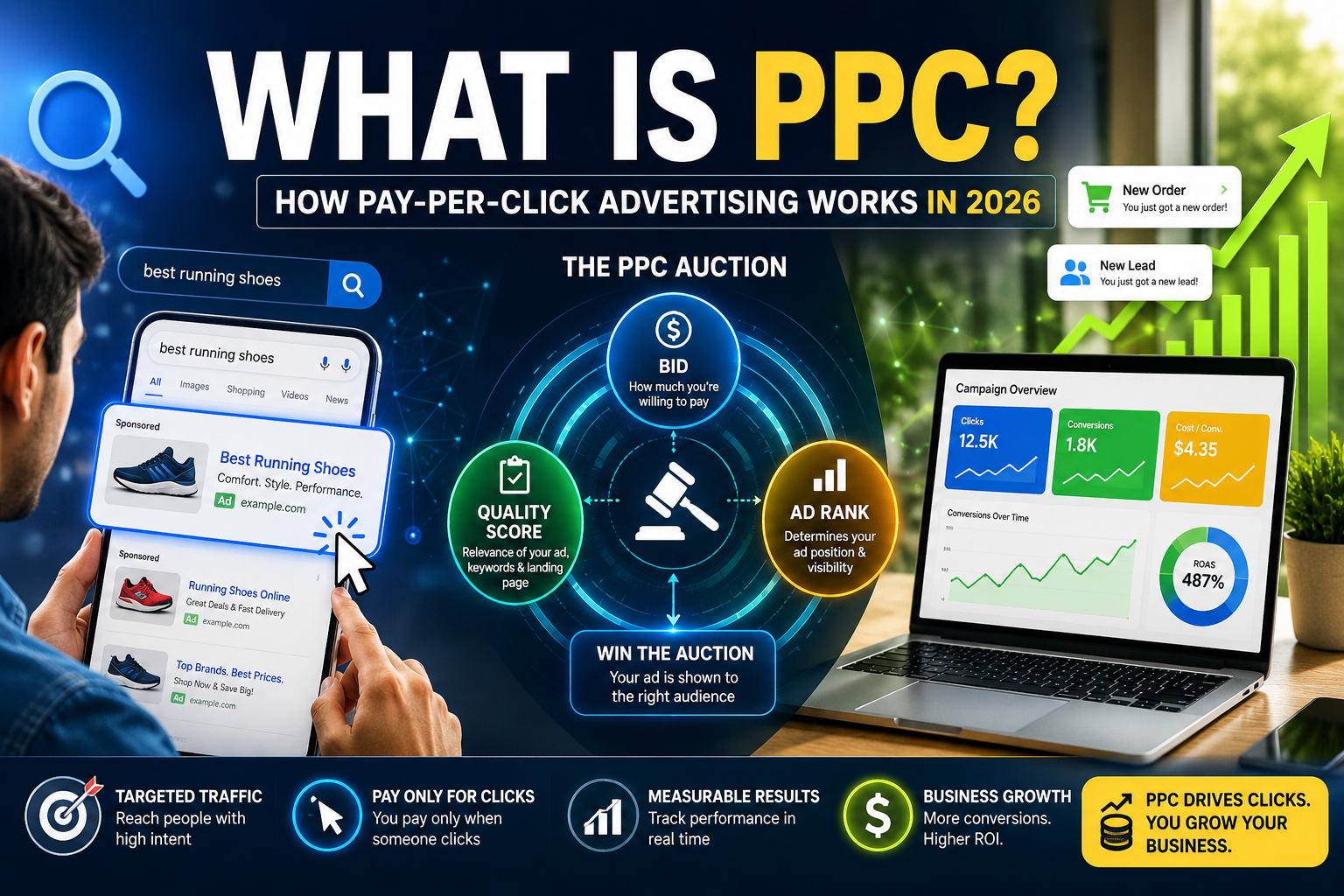
If you have ever searched for a product or service on Google, you have likely noticed the advertisements that appear at the top of the search results. These ads operate under the PPC (Pay-Per-Click) model. In today’s digital marketing landscape, PPC has become a crucial channel for businesses aiming to reach targeted customers quickly.
PPC (Pay-Per-Click) is a digital advertising model where the advertiser pays only when a user clicks on their ad. Platforms such as Google Ads, Microsoft Advertising, Meta Ads, and others utilize this model. PPC offers businesses immediate traffic, precise targeting, and measurable results.
What is PPC?
PPC stands for Pay-Per-Click. This means the advertiser pays only when someone clicks on their advertisement.
This model is primarily used on the following platforms:
- Google Ads
- Microsoft Advertising
- Facebook and Instagram Ads
- LinkedIn Ads
- TikTok Ads
- Amazon Ads
Unlike SEO, where results can take time to materialize, PPC campaigns can generate traffic and leads within hours if set up correctly.
How does PPC work?
PPC is based on a real-time auction system. When a user searches for a specific keyword, advertisers compete for that keyword.
Ad positioning depends primarily on three factors:
- Bid: The maximum amount an advertiser is willing to pay per click.
- Quality Score: This is based on the relevance of the ad and the quality of the keyword and landing page.
- Ad Rank: Google combines these factors with the user’s location, device, and search context to determine which ad appears at the top.
This does not mean that the advertiser spending the most money will always secure the top spot. A high-quality ad can perform well even at a low cost.
Key Benefits of PPC
Immediate Results
Compared to SEO, PPC can attract traffic and potential customers much faster.
Precise Targeting
You can target your ads based on location, language, age, device, and interests.
Full Budget Control
Spending can be kept in check by controlling daily budgets and maximum bids.
Easy Performance Measurement
Key metrics like clicks, impressions, conversions, and ROI are easily accessible.
Scalability
Campaigns that perform well can easily be scaled up.
Types of PPC Campaigns
Search Ads
Text-based ads that appear in Google search results, helping to reach users with clear purchase intent.
Display Ads
Banner and image-based ads that appear across various websites and apps.
Shopping Ads
Useful for e-commerce businesses; these display product images, prices, and store information.
Video Ads
Ads running on YouTube and other video platforms that help boost brand awareness.
Social Media Ads
Ads displayed on platforms like Facebook, Instagram, LinkedIn, and TikTok based on audience interests.
Key PPC Platforms in 2026
Google Ads
The world’s most popular advertising platform, considered the most effective for generating search-based traffic.
Microsoft Advertising
A great option for many businesses due to lower competition and relatively lower CPC.
Meta Ads
Enables businesses to reach a vast number of consumers via Facebook and Instagram.
LinkedIn Ads
Particularly useful for B2B companies and professional services.
Amazon Ads
A highly effective advertising platform for e-commerce brands.
The Growing Impact of PPC and AI
In 2026, Artificial Intelligence is rapidly transforming the digital advertising industry.
Google’s AI-driven features and automated campaigns are making ad management more efficient. Moreover, businesses no longer rely solely on traditional SEO; they are also focusing on AI Search Optimization and Generative Engine Optimization (GEO).
Consequently, a balanced use of both SEO and PPC has become more crucial than ever in modern digital marketing.
Key PPC Metrics
A successful PPC campaign is measured based on the following indicators:
- CTR (Click-Through Rate)
- Average CPC
- Quality Score
- Conversion Rate
- CPA (Cost Per Acquisition)
- ROAS (Return on Ad Spend)
- ROI (Return on Investment)
Regular monitoring of these metrics helps improve campaign performance.
What is the difference between PPC and SEO?
Many people view PPC and SEO as competitors, but in reality, they complement each other.
When should you choose PPC?
- If you need immediate traffic.
- When launching a new product or service.
- For running limited-time campaigns.
When should you choose SEO?
- If you want long-term, sustainable traffic.
- To build brand credibility.
- If you do not want to pay for every click.
For most businesses, a combined approach using both SEO and PPC proves to be the most effective strategy.
Conclusion
PPC is a powerful digital marketing channel that offers businesses rapid results, superior targeting, and measurable performance. However, simply running ads is not enough; achieving successful outcomes requires the right keywords, high-quality landing pages, and continuous optimization.
In 2026, as AI and search engines continue to evolve, integrating both SEO and PPC can be considered the best approach to building a robust digital strategy.
Frequently Asked Questions
What is the difference between PPC, CPC, and CPM?
PPC (Pay-Per-Click) is an advertising model where the advertiser pays only when a user clicks on their ad. CPC (Cost Per Click) is the metric that indicates the average cost of each click. Meanwhile, CPM (Cost Per Mille) is used to measure the cost per 1,000 impressions, regardless of whether the user clicks on the ad or not. Typically, the CPC model is used in PPC campaigns, whereas the CPM model is more popular for branding and awareness-building campaigns.
What should be the minimum budget to start PPC?
There is no fixed minimum budget for a PPC campaign, as it depends on the industry, competition, and goals. In low-competition sectors, a budget of 500 USD to 1000 USD per month can yield good results. However, highly competitive sectors such as insurance, finance, travel, and legal services, may require a larger investment. The key is to allocate enough time and budget to the campaign so that the algorithm can gather sufficient data for better optimization.
Is PPC still profitable despite the rise of AI-powered search engines?
Yes, PPC remains an effective and profitable marketing channel. However, the digital marketing landscape is constantly evolving, and AI-based search experiences are developing rapidly. Therefore, rather than relying solely on paid ads, it is considered more beneficial to use PPC in a balanced way alongside strategies like SEO and Generative Engine Optimization (GEO).
How long does it take to see results from a PPC campaign?
Impressions, clicks, and initial data begin to appear within a few hours of launching a PPC campaign. However, it generally takes 2 to 6 weeks for automated bidding strategies and AI-based campaigns to learn and optimize effectively. With regular improvements and analysis, campaign performance tends to improve over time.
Is it better to manage PPC in-house or seek help from an agency?
It depends on your team’s expertise and available time. If you have significant experience with Google Ads and other advertising platforms, you can manage the campaigns yourself. However, if your team lacks sufficient experience or time, enlisting the help of an experienced PPC agency can be more beneficial. The right strategy and regular optimization can yield a better ROI in the long run.
Do PPC and SEO harm each other?
No, PPC and SEO complement each other rather than compete. When a brand appears in both organic and paid search results, its visibility and click-through rate (CTR) are likely to increase. Furthermore, data from PPC campaigns helps identify which keywords drive the most conversions, allowing for a more effective SEO strategy. For optimal results, both channels should be utilized together in a coordinated manner.