
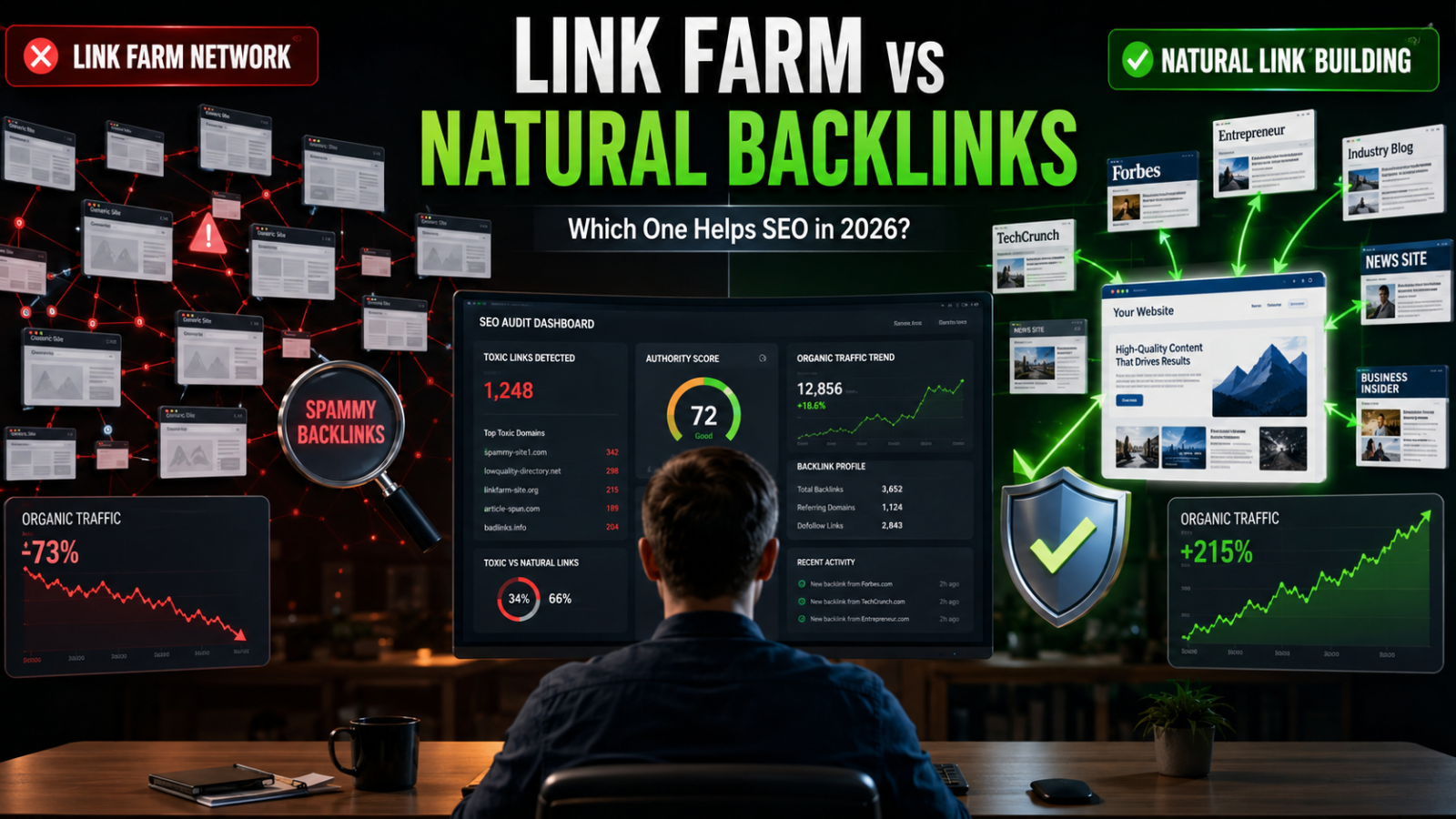
A link farm is a network of websites created primarily to generate artificial backlinks and manipulate search engine rankings. Link farms violate Google’s spam policies and can lead to lost rankings, reduced visibility, or manual penalties. Modern Google systems such as SpamBrain are designed to identify and neutralize these manipulative linking practices.
What Is a Link Farm?
A link farm is a group of websites built primarily to create backlinks for one another or for specific target websites in an attempt to influence search engine rankings. Rather than earning links naturally through valuable content, these networks exist mainly to manipulate ranking signals.
This practice has long been considered a Black Hat SEO tactic and has been targeted by Google for years. Since the launch of major anti-spam updates, including Penguin and more recently SpamBrain, link farms have become increasingly risky and far less effective than they once were.
Over the years, many website owners have unknowingly become involved with link farms after purchasing low-cost link-building services that promised quick ranking improvements. In many cases, the short-term gains are followed by long-term visibility issues that can take months to resolve.
When investigating sudden ranking drops, one of the first areas SEO professionals typically review is the website’s backlink profile. It’s not uncommon to discover hundreds of suspicious backlinks coming from low-quality websites that exist solely to pass link equity rather than provide genuine value to users.
Understanding how link farms work and how to avoid them, is essential for anyone focused on sustainable SEO growth.
Why Link Farms Still Matter in Modern SEO
Although search engines have become much better at detecting manipulative links, link farms haven’t completely disappeared. Instead, they have evolved.
Some networks now use expired domains, AI-generated content, and more sophisticated publishing methods to appear legitimate. However, the underlying goal remains the same: creating artificial authority through manufactured backlinks.
The challenge for website owners is that not all harmful links are easy to identify at first glance. What appears to be a harmless backlink package can sometimes expose a website to unnecessary risk.
That’s why understanding the warning signs is more important than ever.
What Does a Link Farm Look Like?
A typical link farm is made up of websites that offer little or no real value to visitors. Their primary purpose is to host links rather than publish useful information.
Common characteristics include:
- Thin, duplicated, or poorly reviewed content
- Large numbers of outbound links pointing to unrelated websites
- Generic website designs with little branding or editorial identity
- Very low organic traffic and limited search visibility
- Excessive use of keyword-rich anchor text
- Articles created solely to place backlinks
While individual sites may appear harmless, the overall pattern often reveals an organized network designed to manipulate rankings.
The intention is straightforward: create the appearance of popularity and authority by generating large numbers of backlinks. However, modern search engines are increasingly effective at distinguishing genuine recommendations from artificial link schemes.
The Evolution of Google’s Fight Against Link Farms
To understand why link farms pose such a significant risk today, it helps to look at how Google’s approach to link quality has evolved over time.
1998: The Introduction of PageRank
When Google launched, PageRank revolutionized search by evaluating webpages based on the links pointing to them.
The concept was simple: if many reputable websites linked to a page, that page was likely valuable.
However, this system also created an opportunity for manipulation. If links influenced rankings, some website owners would inevitably try to manufacture them.
2000–2011: Rapid Growth of Link Networks
During the early years of SEO, link farms became widespread.
Large numbers of backlinks could be acquired quickly and cheaply. In some cases, websites achieved strong rankings largely because of artificially inflated link profiles.
At the time, search engines had fewer tools available to distinguish natural links from manipulative ones.
As a result, many businesses invested heavily in link-building tactics that would later become high-risk strategies.
2012: The Penguin Update Changes Everything
Google’s Penguin update marked a major turning point in SEO.
Designed specifically to target manipulative link practices, Penguin significantly reduced the effectiveness of low-quality backlink schemes.
Many websites that relied on artificial links experienced dramatic ranking losses almost overnight.
For the SEO industry, Penguin reinforced an important lesson: quality matters far more than quantity.
2016: Real-Time Link Evaluation
Google later integrated Penguin directly into its core algorithm.
This allowed the search engine to evaluate link quality on an ongoing basis rather than waiting for major update cycles.
As a result, websites could recover more quickly from link-related issues, but they could also be affected more quickly when risky practices were detected.
2022 and Beyond: The Rise of SpamBrain
Google’s SpamBrain system introduced a more advanced approach to identifying spam.
Using machine learning, SpamBrain can recognize patterns associated with manipulative link-building tactics and neutralize their impact.
Rather than simply penalizing websites, Google increasingly focuses on ignoring or discounting links that appear unnatural.
This means that even if a link farm avoids triggering a direct penalty, the links themselves may provide little or no ranking benefit.
Recent Spam Updates Continue Raising the Bar
Recent spam-focused algorithm updates have significantly improved Google’s ability to detect and penalize manipulative SEO practices, including:
- Scaled content abuse
- Expired domain abuse
- Site reputation abuse
- Manipulative link networks
- Automated publishing systems
As search engines become more advanced, relying on artificial backlinks is becoming an increasingly risky and ineffective strategy.
For most websites, building genuine authority through high-quality content, expertise, and user value is now the safest and most sustainable path to long-term SEO success.
How Does a Link Farm Work?
While link farms vary in size and sophistication, most operate using a similar framework.
1. Domain Acquisition
Operators acquire multiple websites, often by purchasing expired domains that already possess backlinks, traffic history, or existing authority.
2. Content Production
The network is populated with large volumes of content, frequently generated at scale and published with minimal editorial oversight. The primary goal is often not to inform readers, but to create pages capable of hosting backlinks.
3. Link Placement
Backlinks are strategically inserted throughout the content, typically using keyword-rich anchor text intended to influence search engine rankings.
4. Link Distribution or Sales
The links may be used to boost the operator’s own websites or sold to external clients through SEO and link-building packages.
Although these networks can initially appear authoritative, modern search engines are increasingly effective at identifying the patterns that connect them.
Once detected, much of their perceived SEO value can disappear, and participating websites may face ranking declines or manual penalties.
How to Identify a Link Farm: 8 Common Warning Signs
Recognizing a link farm is often easier than many website owners realize. While no single factor proves a site is part of a link scheme, multiple warning signs appearing together should prompt closer examination.
1. Excessive Outbound Links
Legitimate websites link to relevant resources when they add value for users.
Link farms, by contrast, often contain an unusually high number of outbound links pointing to unrelated websites. When links vastly outnumber meaningful content, it is often a strong warning sign.
2. Low-Quality or Repetitive Content
Many link farms publish content that provides little original value.
Common indicators include:
- Thin or superficial articles
- Duplicate or recycled content
- Poor grammar and editing
- Generic, broad-topic coverage
- Pages created primarily to host backlinks
Authentic websites focus on serving readers. Link farms focus on distributing links.
3. Generic Design and Weak Branding
A lack of clear branding, author information, editorial guidelines, or company details may indicate a low-quality network.
While design alone does not determine credibility, many link farms invest little effort in creating a trustworthy user experience.
4. Unrelated Topics Across the Site
A website that publishes content about health, cryptocurrency, travel, finance, pets, and home improvement within a short period may lack genuine topical authority.
Most reputable websites maintain a consistent focus within their area of expertise.
5. Unnatural Backlink Growth
A sudden surge in backlinks without corresponding media coverage, marketing activity, or viral content success can suggest artificial link-building efforts.
Rapid growth is not always problematic, but unexplained spikes often warrant further investigation.
6. Over-Optimized Anchor Text
Natural backlink profiles typically include a diverse mix of:
- Brand names
- Naked URLs
- Generic phrases
- Contextual references
When a large percentage of backlinks use exact-match commercial keywords, it may indicate an attempt to manipulate rankings.
7. Little or No Organic Traffic
A website that links to numerous businesses yet attracts very little organic search traffic may not be a credible authority source.
Traffic metrics alone are not conclusive, but they can provide valuable context when evaluating link quality.
8. Shared Ownership Signals
Multiple websites that share hosting environments, ownership details, publishing patterns, design templates, or registration information may be part of a coordinated link network.
While sophisticated operators work to conceal these connections, many smaller networks leave detectable footprints.
Link farms are designed to manipulate search rankings rather than provide value to users. As Google’s spam detection systems continue to evolve, the risks associated with these networks are increasing while their effectiveness continues to decline.
For sustainable SEO growth, businesses are far better served by earning high-quality backlinks naturally through authoritative content, strong brand building, and genuine industry relationships.
What Happens If Google Detects Links from a Link Farm?
The impact of receiving links from a link farm can range from a gradual decline in rankings to a significant loss of organic visibility. The exact outcome depends on the quality of the links, the scale of the issue, and how Google’s systems evaluate the website’s overall backlink profile.
In practice, three common scenarios tend to occur.
1. Algorithmic Devaluation (Most Common)
Today, Google’s spam detection systems are highly advanced. In many cases, rather than issuing a direct penalty, Google simply ignores low-quality or manipulative links.
When this happens, websites often experience:
- Stagnant rankings despite ongoing SEO efforts
- Reduced keyword visibility
- Slower organic growth
- Declining authority signals
Many website owners don’t realize anything is wrong because they never receive a warning. They simply stop seeing positive results from their backlink strategy.
2. Manual Actions
In more serious situations, Google’s review team may apply a manual action.
When a manual action occurs, website owners receive a notification inside Google Search Console explaining that unnatural links have been detected.
Recovering from a manual action usually requires:
- Identifying harmful backlinks
- Attempting link removals
- Submitting a disavow file when necessary
- Filing a reconsideration request
This process can take weeks or even months depending on the severity of the issue.
3. Long-Term Authority Damage
Sometimes the biggest cost isn’t the penalty itself. It’s the time lost.
A website that relies heavily on manipulative backlinks often misses opportunities to earn genuine authority through valuable content, editorial mentions, and industry recognition. Once Google stops counting those artificial links, the site may struggle to compete against competitors with stronger and more natural backlink profiles.
What Should You Do If Your Website Receives Links from a Link Farm?
Discovering suspicious backlinks can be alarming, but not every toxic-looking link requires immediate action.
A structured review process helps separate genuine threats from harmless noise.
Step 1: Audit Your Backlink Profile
Begin by reviewing all referring domains using tools such as:
- Google Search Console
- Ahrefs
- Semrush
- Majestic
Look for patterns rather than isolated links. One questionable backlink is rarely a problem. Hundreds of them can be.
Pay attention to:
- Irrelevant websites
- Excessive exact-match anchor text
- Low-quality content sites
- Networks of similar-looking domains
Step 2: Evaluate Link Quality
Not every weak backlink is harmful.
A practical approach is to classify links into three categories:
High Risk
- Obvious spam domains
- Automated link networks
- Hacked websites
- Known link-selling platforms
Medium Risk
- Poor-quality blogs
- Unrelated websites
- Thin-content domains
Low Risk
- Small websites with limited authority
- New websites
- Niche blogs with legitimate content
This process prevents overreacting and accidentally removing links that may still provide value.
Step 3: Request Link Removal
If harmful links are clearly part of a manipulative network, consider contacting the website owner and requesting removal.
While response rates are often low, documenting these efforts can be useful if further action becomes necessary.
Step 4: Use Google’s Disavow Tool Carefully
The Disavow Tool allows website owners to tell Google to ignore specific backlinks during ranking evaluations.
However, it should be used cautiously.
Google generally recommends disavowing links only when:
- There is a significant number of spammy backlinks
- Manual actions are involved
- The links appear intentionally manipulative
Incorrect use of the disavow tool can remove legitimate authority signals and negatively impact performance.
Step 5: Monitor Your Link Profile Regularly
Backlink management is not a one-time task.
Set up regular monitoring so new suspicious links can be identified early. Monthly reviews are usually sufficient for most websites, while larger brands may require more frequent monitoring.
Smarter SEO Strategies Than Link Farms for Sustainable Growth
Building strong search visibility takes time, but ethical SEO practices deliver lasting results that far outweigh the short-term gains of risky backlink schemes. Instead of relying on artificial link networks, businesses should focus on strategies that earn authority naturally and align with search engine best practices.
Earn High-Value Editorial Links
Editorial backlinks are considered one of the strongest indicators of trust and authority. These links occur when other websites voluntarily reference your content because it offers useful insights, credible information, or unique expertise.
Content that commonly attracts editorial links includes:
- Original research and survey findings
- Industry reports and trend analyses
- Data-driven case studies
- Expert commentary and thought leadership articles
- Comprehensive guides and educational resources
Although creating this type of content requires significant effort, the resulting backlinks often provide long-term SEO value and stronger rankings.
Prioritize Quality Guest Posting
Guest blogging remains an effective way to build authority when approached strategically. The goal should be contributing valuable content to reputable websites within your industry rather than publishing on low-quality platforms solely for links.
Best practices include:
- Choosing authoritative and relevant publications
- Delivering insightful, reader-focused content
- Including backlinks only where they naturally fit
- Engaging audiences that align with your niche
Well-executed guest contributions can strengthen brand recognition while generating both referral traffic and SEO benefits.
Create Content That Naturally Attracts Links
Some resources consistently earn backlinks because they provide ongoing value and solve common problems.
Examples of link-worthy assets include:
- Free tools and applications
- Interactive calculators
- Downloadable templates and checklists
- Industry statistics hubs
- Resource centers
- Original surveys and research studies
These assets can continue attracting backlinks long after publication, making them one of the most scalable forms of link acquisition.
Leverage Digital PR for Authority Building
Digital PR combines traditional media outreach with SEO objectives to secure coverage from trusted publications and influential industry sources.
Potential opportunities include:
- News websites
- Trade publications
- Industry blogs
- Business media outlets
- Professional associations
A single mention from a respected publication can often provide greater SEO impact than dozens of links from low-quality websites.
Turn Brand Mentions into Backlinks
Many businesses discover that websites mention their products, services, or company name without linking back to their site.
Monitoring these mentions and reaching out with a polite request for attribution can often result in valuable backlinks. Since the publisher has already acknowledged the brand, these opportunities typically produce higher success rates than traditional cold outreach campaigns.
Why Sustainable Link Building Delivers Better Results
Search engines are increasingly effective at identifying and discounting manipulative link-building tactics. While shortcuts may occasionally generate temporary ranking improvements, they rarely support long-term success.
Strong SEO performance is built on:
- Demonstrated expertise
- Industry authority
- Trustworthiness and credibility
- Exceptional content quality
- Genuine recommendations and citations
- Positive user experiences
These factors continue to hold value through algorithm updates and evolving search engine standards.
Organizations focused on long-term organic growth should invest in ethical link-building strategies that strengthen authority naturally rather than chasing temporary gains through low-quality backlink networks.
Link Farms in the Age of AI: ChatGPT, Perplexity, Gemini, and AI Overviews
The growth of AI-powered search experiences has changed how websites earn visibility online. Today, platforms such as ChatGPT, Perplexity, Gemini, and Google’s AI Overviews do more than rank web pages—they often highlight and reference specific sources directly in their responses.
This shift has made genuine authority more valuable than ever.
In the past, some website owners attempted to boost rankings through artificial link-building tactics. However, modern search systems and AI-powered discovery tools increasingly rely on broader trust signals, including content quality, topical expertise, editorial standards, and real-world credibility.
Why Link Farms Are Less Effective in the AI Era
Large language models evaluate information differently than traditional search algorithms alone.
When determining which sources deserve visibility, AI systems tend to favor websites that demonstrate:
- Consistent topical expertise
- Original and useful content
- Strong editorial standards
- Trustworthy authorship
- Citations and references from reputable sources
- Positive user engagement signals
A website that relies primarily on artificial backlink schemes may struggle to build the level of authority needed to become a trusted source within modern AI-driven ecosystems.
Simply put, genuine expertise is becoming more important than manipulated popularity.
The Rise of AI-Generated Link Farms
Since 2024, the SEO industry has also seen an increase in large-scale networks using AI-generated content to create backlinks at scale.
These networks often feature:
- Mass-produced articles with little editorial review
- Recycled or low-value content
- Expired domains repurposed for linking
- Automated publishing systems
- Minimal user value
Search engines have continued refining their systems to identify and neutralize these tactics. Recent spam policy updates have specifically targeted large-scale content abuse and other manipulative practices designed to influence rankings without providing meaningful value to users.
Building Authority That Lasts
As AI-powered search becomes more prominent, sustainable SEO strategies increasingly focus on:
- Publishing original research and insights
- Demonstrating subject-matter expertise
- Earning editorial backlinks naturally
- Creating genuinely helpful content
- Building a recognizable brand presence
- Maintaining transparency and trust
These practices not only support long-term organic visibility but also improve the likelihood of being referenced across emerging AI-driven platforms.
Link Farms Are a Risky Shortcut With Long-Term Consequences
Over the years, many website owners have been attracted by offers promising hundreds or even thousands of backlinks at extremely low prices. While these offers may appear appealing, the long-term risks often outweigh any short-term gains.
Recovering from a toxic backlink profile can require months of cleanup, monitoring, and rebuilding trust with search engines. In severe cases, websites may experience significant ranking losses that take considerable time and effort to reverse.
The most effective SEO strategies focus on sustainable growth rather than artificial shortcuts.
Building authority through quality content, relevant industry relationships, digital PR, and editorial link acquisition creates a stronger foundation for long-term success.
Whether you manage a small business website, an e-commerce store, or a growing publication, maintaining a clean backlink profile remains one of the most important aspects of protecting your organic visibility.
Frequently Asked Questions About Link Farms
Is using a link farm illegal?
Using a link farm is generally not illegal from a legal standpoint. However, it violates the quality guidelines of major search engines.
The primary risk is not legal action but potential ranking losses, reduced visibility, or the devaluation of backlinks that were intended to improve SEO performance.
Can my website be affected by unwanted links from a link farm?
Search engines have become significantly better at recognizing unsolicited or spammy links that website owners did not intentionally create.
Even so, it’s a good practice to monitor your backlink profile regularly. If suspicious patterns appear, reviewing those links and taking appropriate action can help maintain a healthy SEO profile.
How can I tell if backlinks come from a link farm?
Several warning signs may indicate a link farm:
- Low-quality or duplicated content
- Large numbers of outbound links
- Little or no organic traffic
- Unrelated topics across the website
- Over-optimized anchor text
- Generic designs with limited credibility signals
Evaluating multiple factors together usually provides the clearest picture.
How quickly can search engines identify manipulative link-building?
There is no fixed timeline.
Modern spam-detection systems continuously evaluate websites and link patterns. Some manipulative networks may be identified relatively quickly, while others can take longer to detect.
Because detection methods continue evolving, relying on risky link-building strategies has become increasingly difficult and unpredictable.
Does the disavow tool still help with toxic backlinks?
The disavow tool can be useful in specific situations involving large numbers of problematic backlinks.
However, it should be used carefully and only after a thorough review. Incorrectly disavowing legitimate backlinks may negatively affect a website’s authority.
For many websites, professional analysis is recommended before submitting a disavow file.
What is the difference between a link farm and a PBN?
Both are considered manipulative link-building techniques, but they differ in structure.
A traditional link farm often consists of large numbers of low-quality websites linking aggressively to many domains.
A Private Blog Network (PBN) typically uses more carefully managed websites, often built on expired domains with historical authority.
While PBNs can be more sophisticated, both approaches carry significant SEO risks.
Do professional SEO agencies use link farms?
Reputable SEO professionals generally avoid link farms because the long-term risks outweigh any temporary ranking benefits.
Modern SEO focuses on earning links through content quality, digital PR, industry relationships, editorial placements, and other sustainable strategies that align with search engine guidelines.
How long does recovery take after a link-related penalty?
Recovery timelines vary based on factors such as:
- The severity of the issue
- The number of toxic backlinks
- The website’s overall authority
- The effectiveness of the cleanup process
In some cases, improvements can be seen within a few months. More complex situations may require significantly longer periods of rebuilding trust and authority.
Key Takeaway
The future of SEO belongs to websites that earn trust rather than manufacture it.
Quality content, genuine expertise, strong user experience, and naturally earned backlinks continue to outperform manipulative tactics over the long term. While link farms may promise quick results, building real authority remains the safest and most sustainable path to lasting search visibility.