
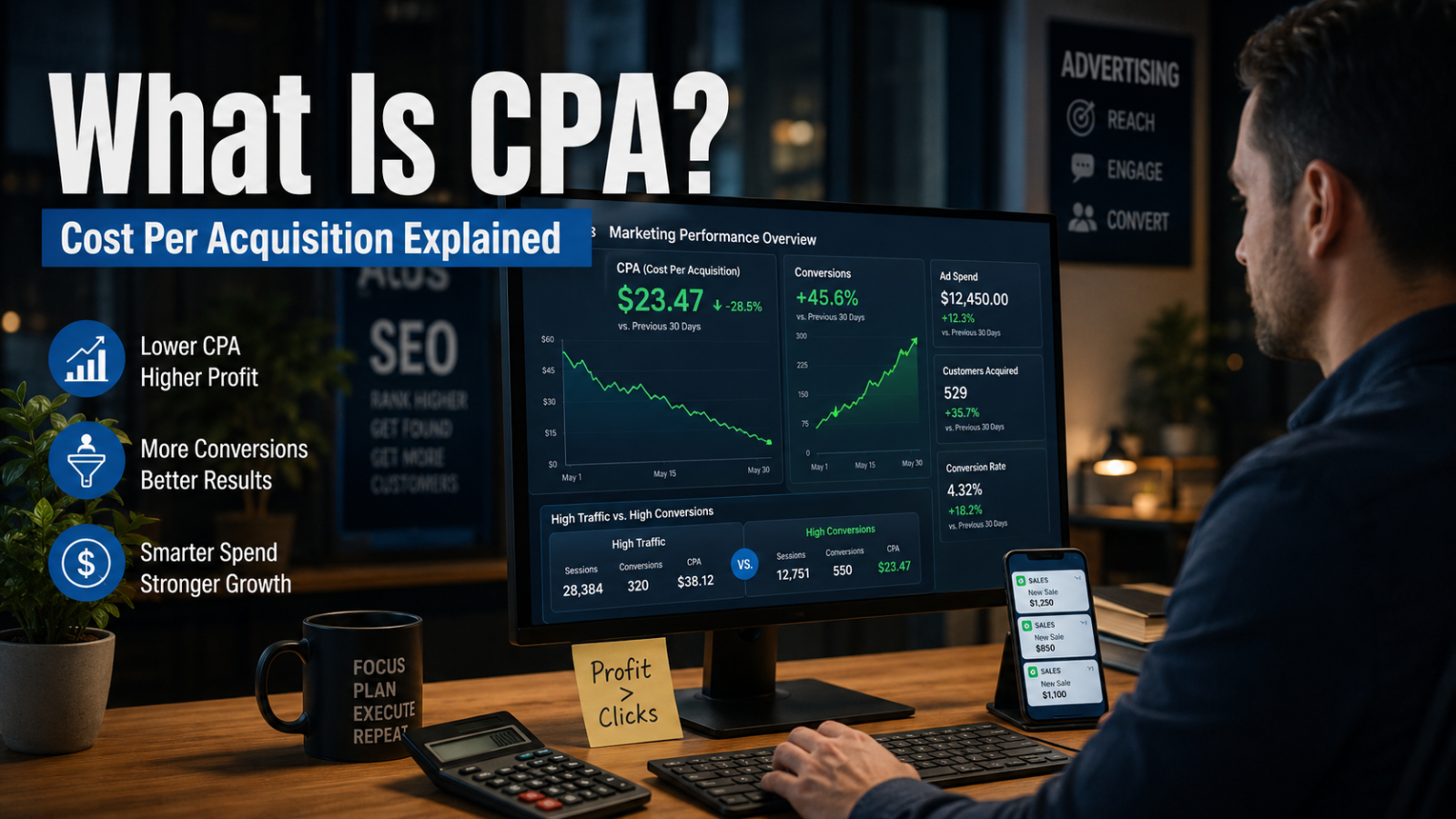
In digital marketing, traffic alone doesn’t pay the bills. A campaign can generate thousands of clicks and still fail to produce meaningful business results. That’s why experienced marketers focus on a much more important metric: Cost Per Acquisition (CPA).
CPA measures how much it costs to acquire a real customer or conversion. Instead of tracking vanity metrics like impressions or clicks, it focuses on actions that directly impact revenue, such as purchases, registrations, form submissions, or quote requests.
For businesses investing in SEO, Google Ads, social media advertising, or email marketing, understanding CPA is essential for making profitable marketing decisions.
What Is CPA?
Cost Per Acquisition (CPA) is a digital marketing metric that measures the average cost required to gain a customer or conversion. It is calculated by dividing the total marketing cost by the number of conversions generated. Businesses use CPA to evaluate campaign profitability and improve marketing performance.
What Does CPA Mean in Marketing?
The term Cost Per Acquisition refers to the amount of money spent to achieve a specific conversion.
That conversion could be:
- A product sale
- A lead form submission
- A newsletter signup
- A phone call
- An app installation
- A free trial registration
Unlike traffic-based metrics, CPA focuses on actual business outcomes.
For example, imagine a local service company spending heavily on paid advertising. The ads may generate thousands of website visits, but if very few people contact the business, the campaign may still be unprofitable. CPA helps reveal whether the investment is truly delivering customers, not just visitors.
This is why CPA has become one of the most important performance indicators in modern digital marketing.
CPA Formula: How to Calculate Cost Per Acquisition
The formula is simple:
Example Calculation
If a business spends:
- $2,000 on Google Ads
- And generates 40 sales
The CPA would be:
That means the business is paying $50 per customer acquisition.
Now consider another marketing channel:
- $800 invested in SEO content and optimization
- 10 conversions generated
The CPA for SEO would be:
In this case, the SEO campaign has a $80 CPA per customer.
At first glance, paid ads appear cheaper. However, SEO traffic can continue generating conversions long after the initial investment, which often improves long-term profitability over time.
That’s why comparing CPA across multiple channels gives businesses a much clearer understanding of marketing efficiency.
What Counts as an “Acquisition”?
One of the biggest misconceptions about CPA is assuming that every business measures acquisition the same way.
In reality, the definition depends entirely on the business model.
Examples of CPA conversions:
| Business Type | Example of Acquisition |
|---|---|
| Ecommerce Store | Completed purchase |
| SaaS Company | Free trial signup |
| Local Service Business | Contact form submission |
| Mobile App | App install or registration |
| Blog or Media Website | Newsletter subscription |
The important thing is that the action being tracked should have genuine business value.
If businesses optimize campaigns around meaningless conversions, they may improve metrics without improving revenue.
Why CPA Matters More Than CPC or CPM
Many beginners focus heavily on:
- CPC (Cost Per Click)
- CPM (Cost Per Thousand Impressions)
While these metrics are useful, they only measure traffic or visibility, not profitability.
Here’s the difference:
| Metric | What It Measures | Best Used For |
|---|---|---|
| CPM | Cost per 1,000 impressions | Brand awareness campaigns |
| CPC | Cost per click | Traffic generation |
| CPA | Cost per conversion | Revenue-focused campaigns |
A campaign can have:
- A very low CPC
- Excellent click-through rates
- Strong traffic numbers
…but still lose money if visitors don’t convert.
On the other hand, some campaigns may have expensive clicks but still generate excellent profits because they attract highly motivated buyers.
That’s why experienced marketers often prioritize CPA over vanity metrics.
Real-World Example: Why CPA Can Change Marketing Decisions
Consider a small online furniture store running Facebook Ads.
The business owner notices:
- High website traffic
- Thousands of ad clicks
- Strong engagement metrics
Initially, everything appears successful.
But after calculating CPA, they discover the business is spending $120 to acquire customers who only generate $90 in profit.
Suddenly, the campaign no longer looks profitable.
This is exactly why CPA is such a powerful metric, it reveals whether your marketing efforts are truly sustainable or quietly draining your budget.
Target CPA in Google Ads
Inside Google Ads, CPA is also used as an automated bidding strategy called Target CPA.
With this system:
- Advertisers set the maximum amount they want to pay per conversion
- Google’s algorithm automatically adjusts bids
- The goal is to maximize conversions within the target cost
However, this strategy only works effectively when enough conversion data exists.
Google generally recommends:
- At least 30–50 conversions in the previous 30 days
- Properly configured conversion tracking
Without reliable data, automated bidding can become unstable and produce poor results.
CPA in SEO: Organic Traffic Also Has a Cost
Many people associate CPA only with paid advertising, but SEO also has acquisition costs.
Even organic traffic requires investment, including:
- Content creation
- Technical SEO
- Keyword research tools
- Link building
- Agency services
- Internal staff time
To calculate SEO CPA:
- Add all SEO-related costs
- Divide them by the number of organic conversions
What makes SEO especially valuable is that content can continue generating traffic and conversions for months or even years after publication.
Unlike paid ads, traffic does not disappear immediately when spending stops.
This long-term compounding effect is one reason businesses continue investing heavily in SEO strategies.
What Is Considered a Good CPA?
There is no universal “perfect” CPA.
A profitable CPA depends on:
- Product pricing
- Profit margins
- Customer retention
- Lifetime customer value
This is where Customer Lifetime Value (LTV) becomes important.
Example:
If the average customer generates:
- $500 in lifetime revenue
Then:
- A $100 CPA may be completely sustainable and profitable for the business.
However, for products with smaller profit margins, even a $30 CPA could become difficult to maintain over the long term.
General Industry Benchmark
Many marketers aim to keep CPA below:
In other words, acquisition costs should ideally remain under 20-30% of customer lifetime value.
Still, every industry operates differently. Some businesses intentionally accept high initial acquisition costs because repeat purchases or long-term subscriptions make customers highly profitable later.
Common Mistakes Businesses Make With CPA
Ignoring customer quality
Not every conversion has equal value. A cheap lead that never converts into revenue is not truly profitable.
Tracking the wrong conversions
Measuring low-value actions can create misleading campaign data.
Focusing only on paid ads
Organic SEO, email marketing, and referral traffic also have acquisition costs that should be measured.
Optimizing too early
Automated bidding strategies need enough conversion data before they can perform effectively.
Final Thoughts
Cost Per Acquisition (CPA) is far more than a basic marketing metric. It gives businesses a clear picture of whether their marketing campaigns are actually generating profitable results, not just traffic numbers that look good on a dashboard.
A campaign may attract thousands of visitors, but if those visitors never convert into paying customers, the marketing investment can quickly become unsustainable. That’s why experienced marketers focus less on vanity metrics and more on measurable business outcomes.
Whether you run:
- An ecommerce store
- A local service business
- A SaaS platform
- Or a content-driven website
understanding CPA helps you identify which marketing channels are truly driving growth and which ones may be wasting budget.
tracking CPA helps you make smarter decisions about where to invest your marketing budget.
And in today’s increasingly competitive digital landscape, that level of clarity can make a major difference in long-term growth.